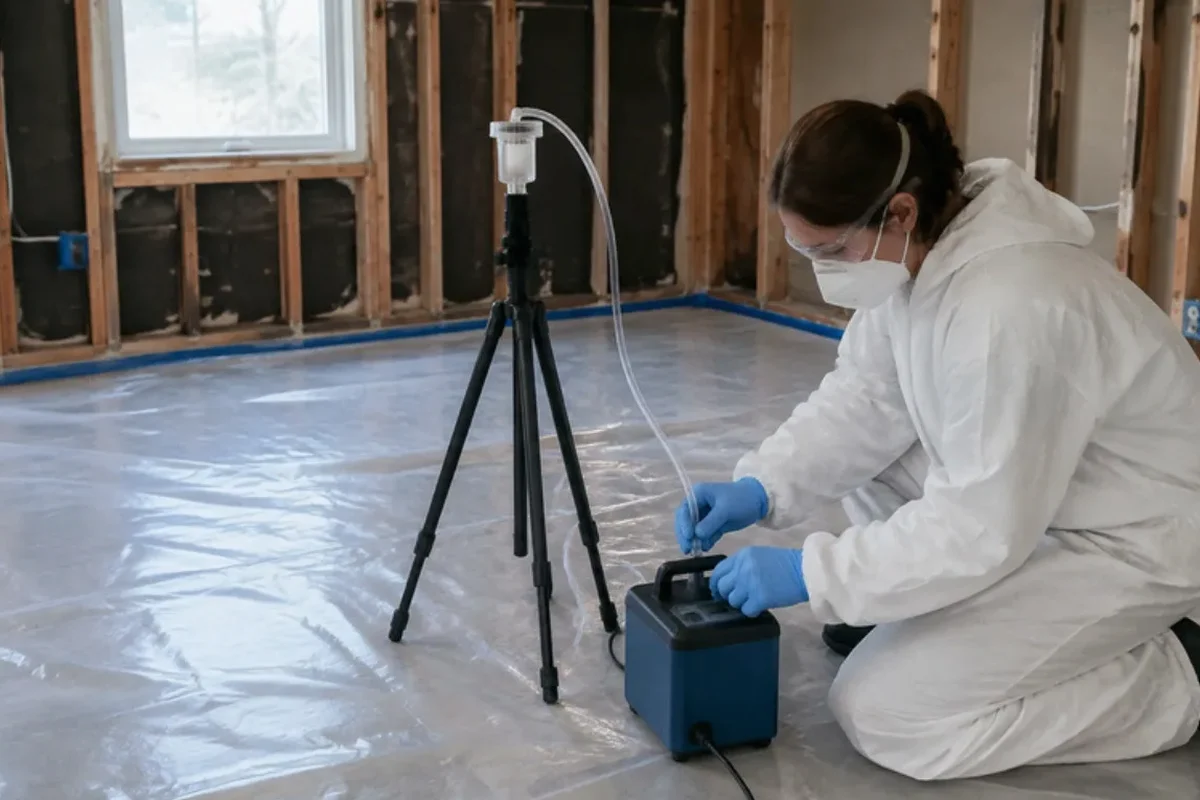
A clearance check usually happens after the work zone is cleaned and before containment is taken down or new drywall goes up. That timing lets the assessor see every surface. Call the number on this page to be connected with a local mold company in Dayton.

When a final check makes sense
Consider it after any job that involved sealed containment, removal of drywall or insulation, or a larger area than a homeowner would clean alone. It also fits when a lender, buyer or tenant has asked for proof, or when someone in the home worries the work was not thorough.
Crawl spaces, attics and ducts
Hard-to-see places get their own review. An assessor may crawl under the house, look at roof sheathing or inspect an air handler. Wet insulation, vapor barriers that have shifted and disconnected duct sections are common findings that a simple room check would miss.
In the 2000s homes around Dayton, mechanical rooms and attic ducts are common leak points, and a final review should include them when the original problem came from the HVAC system.
If your Dayton property is close to a wash or waterway, ask the assessor how the final review accounts for ground moisture and whether grading or drainage was corrected.
Size of the affected area
A single bathroom wall is simpler to review than a whole floor, a full attic deck or a multi-unit building. Square footage, the number of containment zones and how many places need samples drive the visit length and the report's detail.
Permits and license checks in Dayton
Owners of single-family homes who hire a contractor holding a Nevada license may be able to claim un-recovered damages from the board's Residential Recovery Fund, which is one more reason to confirm the license first.
Keep the inspection report, the scope of work and any clearance results together; buyers, landlords and insurers often ask for them later.
Remediation itself is cleanup, but putting the room back together can be permitted work; ask the contractor whether the Lyon County building department needs to be involved.
Water that came in from outside raises insurance questions; FEMA's flood map search shows whether the property sits in a mapped flood zone.
Calls from Dayton are often matched with companies that also cover Carson City, Silver City and Virginia City.
If the area does not pass
The remediator should return, re-clean, and address any moisture left behind. The assessor then repeats the check. Ask how many rounds are included and what happens if it keeps failing. A company that explains this up front is easier to work with.
If a smell returns
A musty odor after a cleared job means moisture is back or was missed. Do not mask it with sprays or paint. Call the company that did the work and an assessor, describe where the smell is strongest and ask for a re-inspection of that wall, floor or duct.
Dayton at a glance
Calls come in from across Dayton, including around Dayton Valley, Santa Maria Ranch, Riverpark.
The Carson River runs through Dayton, so homes near the river corridor are worth checking for drainage and moisture.
Post-Remediation Clearance Testing questions in Dayton
Do I need air sampling?
Is a clearance report useful when selling a home?
Can I request a check on a cleanup done long ago?
Should I keep monitoring after a pass?
More mold services in Dayton
Post-Remediation Clearance Testing nearby
Helpful guides
Sources
- Lyon County Community Development, Building Department
- Nevada State Contractors Board: handyman exemptions and license search
- Nevada State Contractors Board: Residential Recovery Fund
- EPA: A Brief Guide to Mold, Moisture and Your Home
- Nevada Real Estate Division: Seller's Real Property Disclosure form
- Dayton housing by year built
- Dayton: local background
Last updated: